Three Ways to Make a Quilt Feel Like Yours
You can start with the exact same pattern as someone else and end up somewhere completely different. The pattern is only the beginning. The maker is still in there, in the fabric choices and the scale and the arrangement, in the things that got changed on purpose and the things that happened by accident.
If you're working from a pattern and it feels like you're just following instructions, here are three places to start.
1. Change the fabric
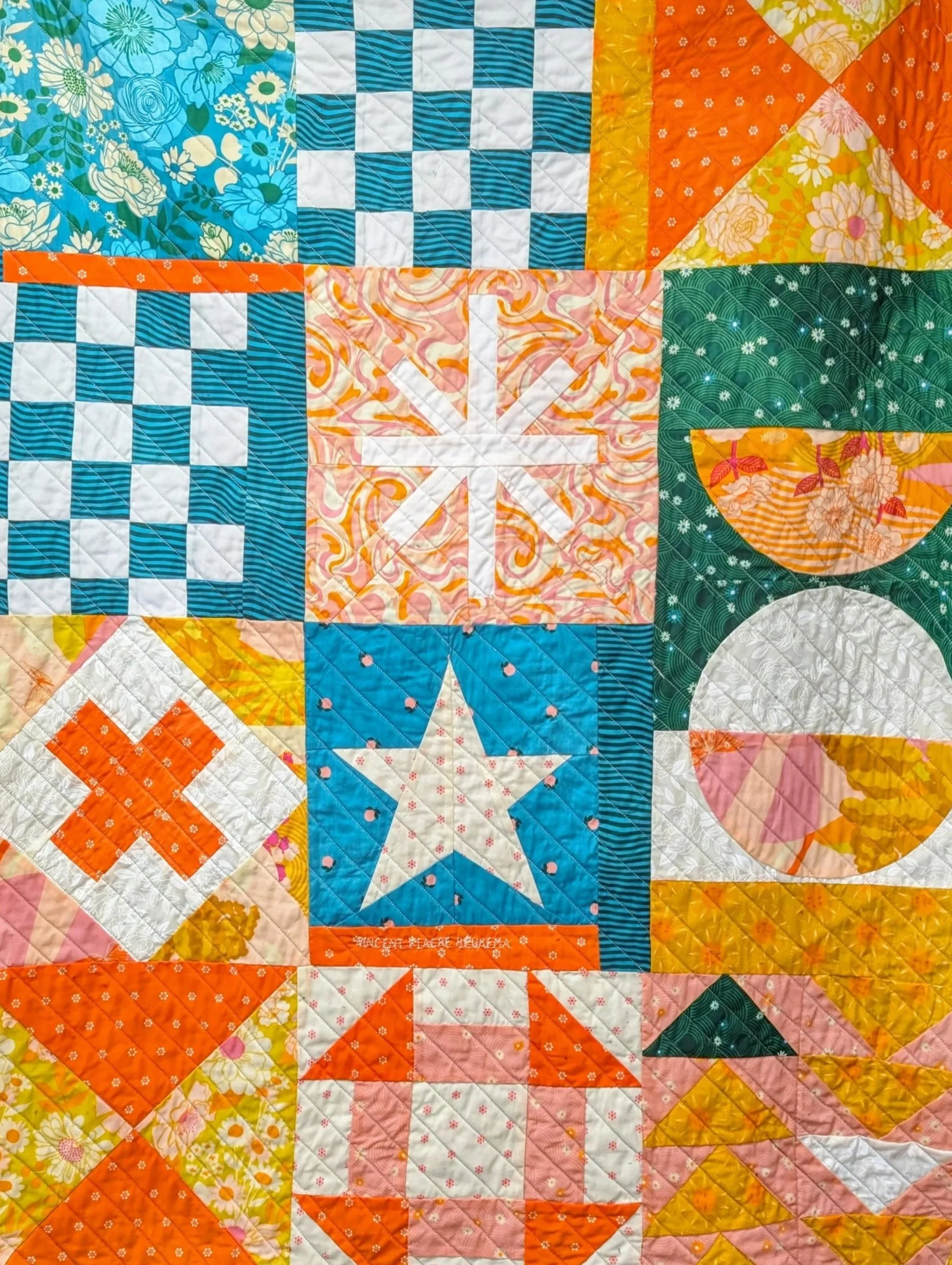
The obvious one, and still the most powerful. A pattern looks like a different quilt in brights than it does in quiet neutrals.
Try thrifted sheets. Try scraps. Try fabrics that don't obviously belong together. Pick one you love and build the rest around it, or skip the idea of a coordinated palette altogether.
You don't have to use what's shown in the pattern. The designer already made those choices. You get to make yours.
2. Change the scale
A block doesn't have to be the size you first met it at. Make it bigger. Make it smaller. Make one enormous block instead of twenty little ones, or make a handful and give them a lot of room.
This changes the whole feeling of a design without touching its structure. Large shapes go bold and graphic. Small pieces go intricate. Neither is better.
Worth knowing: scale changes construction. Small pieces mean more seams and less tolerance for error, so if you shrink a block, expect it to be harder than the original, not just smaller. Going bigger is usually the easier direction and the more dramatic one.
3. Change the arrangement
This is where it gets interesting.
Make your blocks. Then don't sew them together. Lay them out, move them around, rotate them. Put two similar ones side by side. Separate them. Try something that looks wrong.
Photograph each version. This matters more than it sounds like it should. A photo flattens everything into value and composition, and you'll see problems on a screen that you walked past on the wall. It also lets you compare option three to option one, which your memory won't do honestly.
You may find the arrangement you planned isn't the one you like. That's not a failure, that's designing.
This is the larger idea behind how I teach. I don't want you executing someone else's plan perfectly. I want you to have enough information to make your own decisions.
Learn the technique. Understand the structure. Then start changing things.
Maybe your version ends up close to the original. Fine. Maybe it ends up nowhere near it. Also fine. Maybe you make a mistake and like the mistake better, which is the best outcome available.
The more you make, the more you notice your own preferences. You find out you want a lot of negative space, or that you always need something unexpected in the palette, or that you love tiny pieces, or that you can't stand them. That's an eye, and you can't download one. You make things, you look at them, you make more.
Use the pattern. Borrow the structure. Then change something.
A finished quilt doesn't have to prove you followed instructions. It can just show that you were there.