Three Ways to Make a Quilt Feel Like Yours
You can start with the exact same pattern as someone else and end up somewhere completely different. The pattern is only the beginning. The maker is still in there, in the fabric choices and the scale and the arrangement, in the things that got changed on purpose and the things that happened by accident.
If you're working from a pattern and it feels like you're just following instructions, here are three places to start.
1. Change the fabric
The obvious one, and still the most powerful. A pattern looks like a different quilt in brights than it does in quiet neutrals.
Try thrifted sheets. Try scraps. Try fabrics that don't obviously belong together. Pick one you love and build the rest around it, or skip the idea of a coordinated palette altogether.
You don't have to use what's shown in the pattern. The designer already made those choices. You get to make yours.
2. Change the scale
A block doesn't have to be the size you first met it at. Make it bigger. Make it smaller. Make one enormous block instead of twenty little ones, or make a handful and give them a lot of room.
This changes the whole feeling of a design without touching its structure. Large shapes go bold and graphic. Small pieces go intricate. Neither is better.
Worth knowing: scale changes construction. Small pieces mean more seams and less tolerance for error, so if you shrink a block, expect it to be harder than the original, not just smaller. Going bigger is usually the easier direction and the more dramatic one.
3. Change the arrangement
This is where it gets interesting.
Make your blocks. Then don't sew them together. Lay them out, move them around, rotate them. Put two similar ones side by side. Separate them. Try something that looks wrong.
Photograph each version. This matters more than it sounds like it should. A photo flattens everything into value and composition, and you'll see problems on a screen that you walked past on the wall. It also lets you compare option three to option one, which your memory won't do honestly.
You may find the arrangement you planned isn't the one you like. That's not a failure, that's designing.
This is the larger idea behind how I teach. I don't want you executing someone else's plan perfectly. I want you to have enough information to make your own decisions.
Learn the technique. Understand the structure. Then start changing things.
Maybe your version ends up close to the original. Fine. Maybe it ends up nowhere near it. Also fine. Maybe you make a mistake and like the mistake better, which is the best outcome available.
The more you make, the more you notice your own preferences. You find out you want a lot of negative space, or that you always need something unexpected in the palette, or that you love tiny pieces, or that you can't stand them. That's an eye, and you can't download one. You make things, you look at them, you make more.
Use the pattern. Borrow the structure. Then change something.
A finished quilt doesn't have to prove you followed instructions. It can just show that you were there.
How to Choose Fabric Without Making Yourself Crazy
Fabric selection is where a lot of projects die. Not because it's hard, but because it's infinite. Everything goes with something, nothing goes with everything, and you can spend a whole evening moving pieces around and end up back where you started.
Here's how I keep it small.
Start with what you have, not what you want
Most fabric paralysis comes from shopping. You're choosing from every fabric that exists, which is a much worse problem than choosing from the eleven things in your bin.
I work mostly from thrifted bedsheets, and that's partly a limitation I chose on purpose. What's in the pile is what I get. That takes a decision with infinite options and turns it into one with about a dozen, and a dozen is a size a person can actually think about.
If you have a stash, use the stash. If you're buying, buy less than you think you need.
A note on sheets, since people ask
Percale, 100% cotton. That's the whole spec.
Percale is a plain weave, tight and crisp, and it behaves almost exactly like quilting cotton once it's prepped. Sateen is softer and shiftier and I'd skip it while you're learning. Anything with polyester in it presses badly and won't hold a crease, and you'll fight it the whole way.
Check the tag. If there's no tag, feel it. Cotton percale has a dry, papery hand and a faint rustle. Blends feel slick.
Prep them properly and they'll behave
This is the part people skip and then decide sheets are difficult.
Wash hot, dry hot. You want the shrinking over with, and you want whatever's still in the fibers gone. Iron while damp. Then starch, generously, and press again.
Starched percale cuts like paper. It doesn't stretch on the bias, it doesn't shift under the ruler, and it takes a crease and keeps it. It'll behave better than a lot of quilting cotton straight off the bolt.
Cut around the worn spots and the hems. A flat sheet gives you something like four usable yards, which is more than most people expect.
Then: value, not color
Once you've got a working pile, the only question that really matters is light, medium, dark.
Color is what everyone thinks about and value is what actually makes a quilt read. Two fabrics you love in colors you love will disappear into each other if they're the same lightness. That's the muddy quilt problem, and it's almost always value.
Photograph your pile and look at the photo in black and white. What was obvious in color will often turn out to be four versions of medium.
Aim for a spread. Something genuinely light, something genuinely dark, and the rest in between.
Pick a small number and commit
Three to five fabrics. Not eight.
More fabrics feels generous and reads as noise. A limited palette is what makes a quilt look intentional, and it's also what makes the making faster, because you stop re-deciding every time you pick up a piece.
Choose them, put the rest back in the bin, and don't revisit it. If something isn't working an hour in, swap one. Not all of them.
When you're stuck, add a constraint
If you're circling and can't land, make the decision smaller.
Only fabrics from one shopping trip. Only things that were already in the same drawer. Only three colors. Only one print and the rest solid. Only sheets that came from the same estate sale, which is a rule I've used more than once and which produces oddly coherent results.
An arbitrary rule beats no rule. You're not looking for the correct combination. There isn't one. You're looking for a way to stop deliberating and start sewing.
Pick a handful, prep them properly, check your values, and go. You'll learn more in the first hour of cutting than in an evening of arranging.
The Quilt Police Are Not Coming
Nobody is going to inspect your seams.
I know that sounds obvious. It also isn't how most people behave when they're learning to quilt. There's a nervousness that shows up early and never entirely leaves, the sense that there's a right way to do this and someone is keeping track of whether you managed it.
Nobody is keeping track. There is no certifying body. There's no exam, no license, no board that reviews your work and decides whether you're allowed to call it a quilt.
Where the feeling comes from
Partly it's real. Quilting has judged shows with actual judges and actual standards, and if you enter one, someone genuinely will look at your points and your stitch length. Guilds have opinions. Shops have preferences. Some of that is expertise worth respecting and some of it is just habit.
But almost none of it applies to a quilt you're making for your own bed.
The other part is that quilting inherited a lot of anxiety from somewhere else. Being neat. Not wasting things. Doing it properly. Making something that would hold up to a mother-in-law's eye. That's real history and I don't think it's silly. It just doesn't have to be your history.
What actually happens when your points don't match
The quilt is slightly less crisp than it would have been.
That's it. That's the whole consequence.
Nobody who receives that quilt is going to notice, and if they do notice they aren't going to care. People remember that you made them a quilt. They don't remember the seam allowance.
Meanwhile, the quilts I love most tend to have obvious problems in them. Utility quilts made from worn-out clothes, blocks that don't match because the maker ran out of one fabric and used another. Those quilts weren't made by people worrying about a standard. They were made by people who needed a blanket and used what they had.
The cost of the fear
Here's the part I actually care about, because it isn't really about seams.
The fear stops people from starting. It stops people from cutting into fabric they like, because what if they ruin it. It stops people from trying something they haven't done before. And it keeps experienced quilters making the same safe thing for twenty years, because deviation feels like risk.
That's a lot of unmade work.
What to do instead
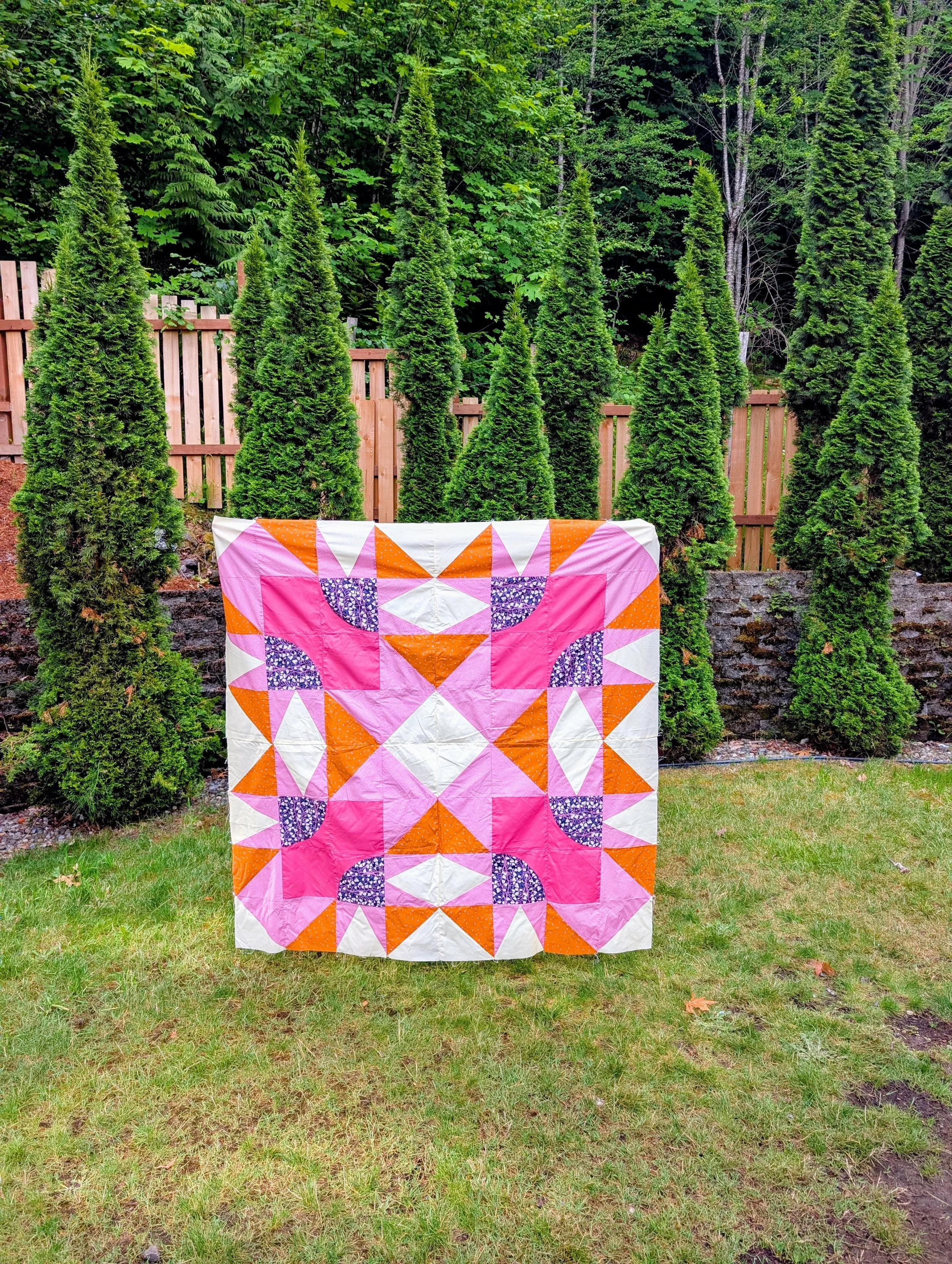
Make something you don't have a plan for. Cut into fabric you're precious about, or better, cut into a dollar bedsheet so the precious part isn't even in play. Finish something imperfect and give it away and watch nobody say a word about it.
Learn the techniques, genuinely. Accuracy is a real skill and it's worth having, because a rule you understand is a rule you can break well. But learn it as a tool, not as a test.
And when you catch yourself hesitating over whether you're allowed to do something: you are. There's no one to ask.
The quilt police are not coming. They were never coming. You can go ahead.
Why I Like Making Bags From Quilt Blocks
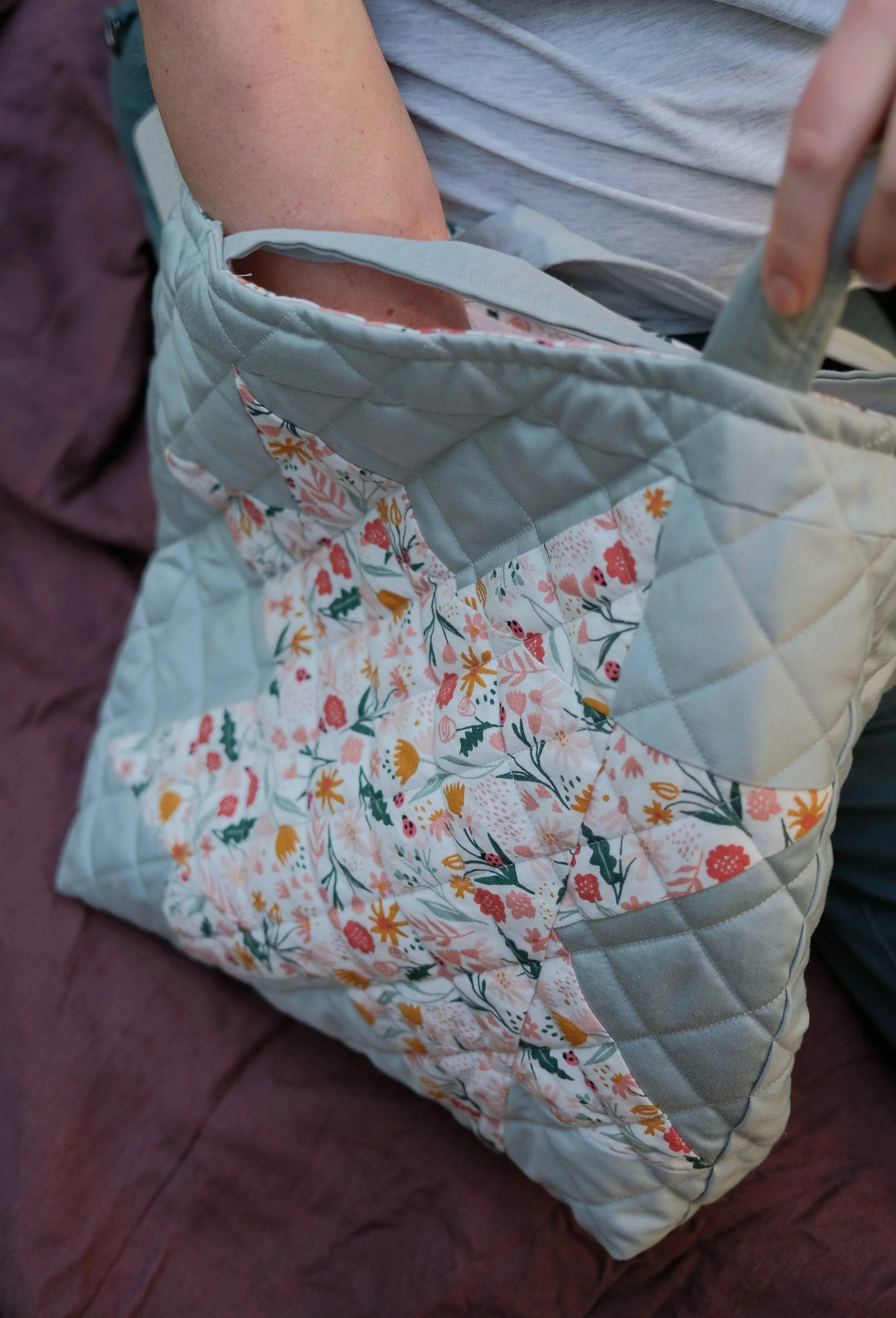
A tote bag is a completely ordinary object. You can buy one for four dollars at the grocery store. Nobody needs a handmade one.
That's exactly why I like making them.
An ordinary thing, made carefully.
There's a particular satisfaction in taking something plain and making it better than it needs to be. A bag is just a bag until it's pieced from a block you improvised, in fabric that used to be somebody's bedsheet, with a lining you chose because it made you happy when nobody will ever see it.
Then it's still a bag. It just happens to be a good one, and it's yours in a way a purchased one never is.
Elevating a basic is more interesting to me than making something precious. Precious things get put away. A bag gets used until it wears out, and I like that better.
You finish it the same day.
This is the honest reason I keep coming back.
A quilt is weeks. Sometimes months. There's a long stretch in the middle where you can't tell if it's working and you just have to keep going on faith. That stretch is real and it's where a lot of projects die in a closet.
A bag is a Saturday. You cut in the morning, you piece the block, you build the thing, and by dinner you're holding it. That's not a small pleasure. That's most of the pleasure.
I don't think we talk enough about how much of making is just wanting to see the finished thing. There's no shame in wanting the payoff sooner.
One block, all the way.
A quilt block on the side of a bag is the whole composition. It doesn't get lost among forty others, it doesn't get averaged out. It's the only thing there.
So the block has to be good, which makes you pay attention to it in a way you don't when you're making the twenty-third one in a series.
Then you carry it around.
A quilt lives on a bed. A bag goes to the store, the class, the post office. It's a quilt block out in the world at eye level, and people notice. I've had more conversations about quilting from a tote than from anything I've ever hung on a wall.
There's something good about the fact that the useful thing is also the beautiful thing, and that it's out doing its job rather than being protected.
If you're stuck partway through a quilt, or stuck before starting one, make a bag instead.
One block, one day, and something to carry home.
What I Mean When I Say “Structured Improv”
I love improv sewing, and I also really like rules. It took me a while to work out why those aren't in conflict.
Structured improv sits between two ways of working that most people treat as the only options. Follow a pattern exactly and you know the outcome before you begin. Sit down with no plan and you're free until you're paralyzed. The middle gives you somewhere to start and still lets you find out where you're going.
My favorite part of making something is not knowing what it'll look like when I'm done. That's uncomfortable at first. We're used to seeing the finished thing before we begin: a pattern shows us the quilt, a kit shows us the fabric. There's a real pleasure in knowing where you're headed. There's a different one in not knowing.
Start with one rule.
Say every piece is a rectangle cut from the same width of fabric. That's it, and it does two things.
It changes the question. You're no longer deciding what to make, which is enormous. You're deciding what to do next, which is small enough to answer.
And it makes variation visible. This is the part people miss. When everything is different, nothing stands out. When one thing is held steady, difference becomes information. Twenty minutes in you'll have five pieces and one of them will be more interesting than the others, and you'll be able to see that it is, because the rule gave you something to see it against. That's your direction, and you found it instead of planning it.
Which means a good starting rule holds one thing steady and lets everything else move. Same width, any length. Same shape, any size. Three colors, any arrangement. If your rule doesn't leave you anything to vary, it's a pattern.
When it goes chaotic, diagnose before you fix.
It will go chaotic in the middle. That's not failure, that's the middle, and it's where most people quit.
The instinct is to start changing things. Don't yet. Step back, and figure out which of these it looks like:
Muddy, everything blending. You have a value problem, not a color problem. Photograph it and look at the photo in black and white. Colors that felt different will often turn out to be the same lightness, and that's why it's flat.
Scattered, nothing holding together. Nothing repeats. Pick one thing, a color or a shape or a size, and put it somewhere else too. Repetition is what makes a viewer's eye travel.
Busy, exhausting to look at. Not enough empty space. Every piece is competing and none of them can win.
Fussy and small. Scale. Make the next thing much bigger than feels reasonable.
Four symptoms, four different fixes, and reaching for the wrong one will make it worse. The rule you add isn't telling you what to do. It's helping you see.
This is why traditional technique is worth learning.
People assume improv means skipping it. It's the opposite. Every diagnosis above came from traditional quilting: value and contrast, repetition, negative space, proportion. That vocabulary is what lets you name what's wrong instead of just feeling that something is.
Traditional piecing is where you learn how blocks are built, what happens when you change a seam allowance, what two similar fabrics do when you set them side by side. You learn the rules, and then you have a toolbox of things to break on purpose. Breaking a rule you understand looks different from never knowing it was there.
The goal isn't knowing what you're making before you start. It's being able to make decisions as you go, which takes a different kind of confidence. Not I know this will look good. More like I know what to do when it doesn't.
Start with one rule. Make things until you see something. When it falls apart, find out why before you fix it.
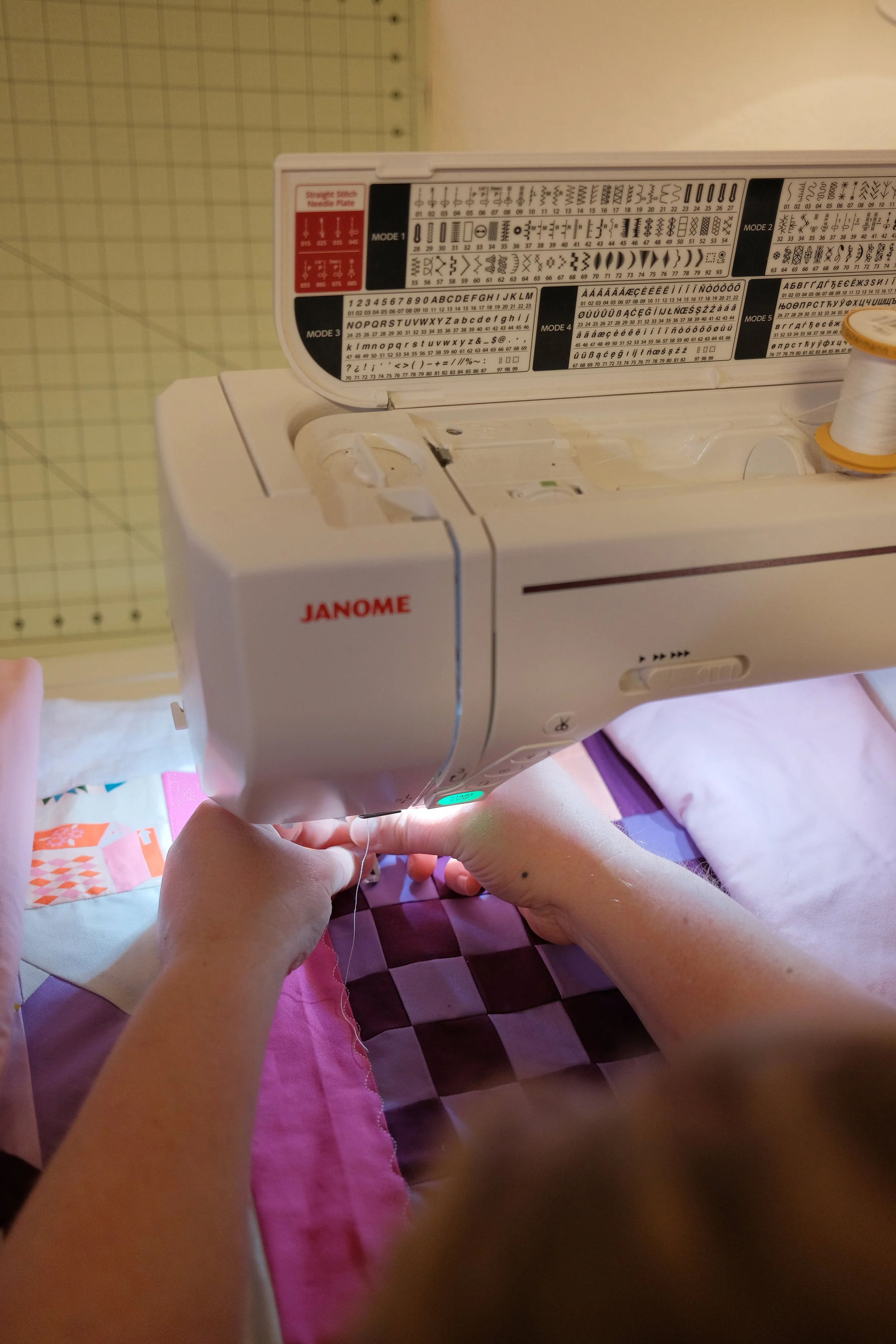
You Don’t Need to Be a Quilter to Make a Quilt
There is a funny thing about quilting: before you are allowed to make a quilt, it can feel like you need to become a quilter.
You need to know the vocabulary. You need a stash of fabric. You need a good sewing machine. You need to understand color. You need to know how to cut perfectly. You need to know what all those rulers are for.
And then, once you've learned all of that, you can finally make something.
I don't think it works that way.
You can make a quilt because you want to make a quilt.
At its most basic, a quilt is a pretty simple thing. There is a top, which might be made from one piece of fabric or from lots of smaller pieces sewn together. There is batting, the soft layer in the middle. And there is a backing, the fabric on the other side.
Put those three layers together, sew them together somehow, and congratulations: you've made a quilt.
Everything else is a rabbit hole.
And I mean that in the best possible way.
There are an enormous number of techniques, traditions, patterns, tools, rules, and very strong opinions in quilting. They are worth learning. They are interesting. Some of them will make your life much easier.
But learning a rule doesn't mean you have to obey it forever.
In fact, I think one of the best reasons to learn the rules is so you know which ones you can ignore.
You can learn why we press seams in a particular direction, and then decide you don't care. You can learn how points are supposed to match and decide that your slightly wonky star has more personality. You can learn how much fabric you're “supposed” to buy and decide to use the three yards you found at a thrift store instead.